Brake System
The brakes are one area where I can save a significant amount of weight compared to the set up used on my Fisher Fury R1. To save money I compromised on the rear brakes and used a standard Escort Mk II setup. On the rear brakes alone it should be possible to save over 5Kg by using higher quality, lighter components.
Brake Pedal
The brake pedal on my Fisher Fury R1 is a heavy lump of steel, despite being full of weight-saving holes. There is no reason not to use a much lighter and more complex structure that also provides greater strength. I expect to save about 300g on this item.
I plan to to measure brake pressure using brake pressure sensor in the front brake circuit. This will be captured in the data logging.
Having looked around, the pedals and pedal box solution developed by AB Performance looks perfect for this application.
Master Cylinders
The plan is to use a twin design with separate pistons and circuits for the front and rear brakes. The brake cylinders were mounted on the chassis bulkhead in my Fury but, I want to avoid this and keep them integrated with the pedal box this time. The two cylinders are different. On the Fury I used a 0.625 inches for the front and 0.75 inches for the rear. Many people that race tend to use a 0.70 inches for the rear though.

| There are pedal box solutions that integrate the master cylinders but, these mean the 'floor' of the footwell is higher. This is not likely to be a problem though. These also provide more flexibility in positioning of the pedals. I would a version of this that supports a cable clutch mechanism and a brake bias bar with adjuster. |
Balance Bar

| The balance bar enabled the correct bias of the braking front and rear, when you are using a twin master cylinder design. Rally Design have a good guide on brake balance bar adjustment. |

| This car will have a remote adjustment knob to change the front/rear brake bias. This is a short length of cable and a light-weight knob, so the additional weight is easily justified. |
Front Calipers
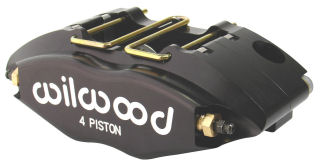
| I've used Hi-Spec billet alloy calipers on my Fisher Fury R1 and these have been pretty good. They are also very small and light. I'm likely to move to Wilwood calipers on this car though. |
Brake Pipes
The brake pipe is 3/16" (4.8mm) 90% copper / 10% nickel (kunifer) pipe. The front pipe runs to the front of the chassis where a 3-way union splits the pipe into two, one to each chassis tab for attaching the front braided hoses. The rear pipe runs down the centre of the car to a 3-way union in front of the differential. This also splits the circuit into two runs, one to each bulkhead fitting for the rear braided hoses. All fittings are metric (M10 x 1) with the exception of the master cylinder ports. For Girling master cylinders the brake port is 3/8" UNF and the feed port is 7/16 UNF which needs 1/4" or larger feed pipe.
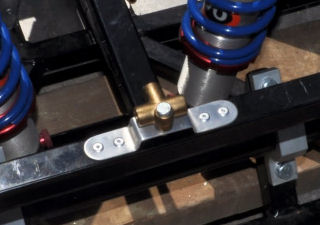
| In the days of the SVA test you were allowed to fit brake unions directly to the chassis using rivnuts but this is not allowed under the new IVA. Picture from this Sylva J15 kit car build blog. Ideally, fitting points like this will be designed into the chassis. |
Brake Hoses
Goodridge stainless-steel, braided hoses are used at each wheel, to connect the brake pipe to the calipers.
Brake Fluid
The brake system requires a quality, Dot 4 brake fluid, e.g. Castrol Response Super Dot 4.

| As part of the data logging I want to log brake pressure. This requires a special brake pressure sensor, which fits in the front brake circuit. |
Rear Calipers
The Sierra calipers and mounts on my Fury R1 weigh 2.7Kg each! This means I can save over 3Kg on the rear calipers alone.
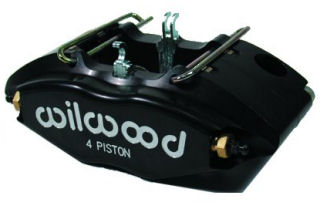
| I will probably use Wilwood calipers again on the rear. This one has an in-built handbrake mechanism and weighs less than 1Kg. |
Brake Discs (Rotors)
The brakes discs used on my Fisher Fury R1 have worked perfectly on road and track. You could drive round on track all day without them over heating. Despite the additional power, I see no need to upgrade them in size or specification.
I'm planning to use 260mm x 7mm grooved discs on the front.
I used standard Escort Mk II solid rear brake discs (253mm x 10mm) on my Fisher Fury R1. These have also worked perfectly but I want something lighter on this car, as they weigh 3455g each.
Brake Pads
To be decided on. With a light car, overall performance becomes less of an issue and I can focus on choosing brake pads that provide the best feel. You won't believe just how quickly my 450Kg Fury R1 will stop. A 400Kg car with better brakes should stop even quicker :-)
Handbrake
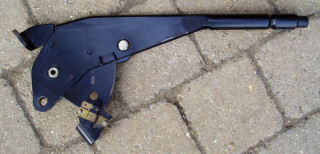
| My Fury handbrake was bought on eBay and was from a Ford Escort. It has an electrical switch to show when it is on/off [650g]. It is not brilliant quality and has some lateral movement and vibrates. |

| My current plan is to use this floor mounting Mk I Ford Focus (1998-2004) handbrake, which I won on eBay for 99p. It is very well made, with an in-built switch [814g]. It is much higher quality than the above handbrake used on my Fury. |

| This photo shows the handbrake mechanism and metal ratchet. It feels very sturdy and has a nice feel to it. |
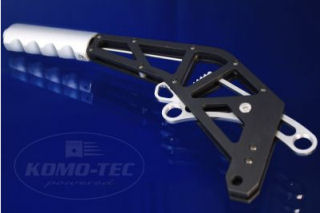
| This is a komo-tec handbrake for the Lotus Elise. Lovely bit of design but it costs €279. |
Handbrake Cable
The handbrake cable on my Fisher Fury R1 is from a standard 2.0 Sierra and is one long unbroken length of cable. The outer sheath routes along the rear wishbones at either side then fits through the chassis brackets. It is very over engineered and very heavy. I plan a much thinner and lighter solution in ths car.
Handbrake Switch
The handbrake warning switch typical connects to ground.
Cooling
I really don't think I'm going to require ducting for air to cool the brakes but this is something I'm currently considering just in case.
Air Brakes
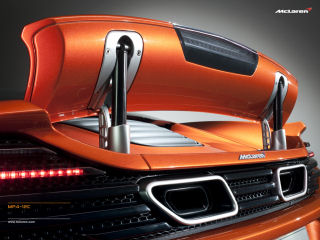
| Some cars (such as the McLaren MP4-12C) have an active spoiler on the rear to assist with braking and to keep more weight over the rear wheels when braking hard from speed. This is something I'm considering but, it adds weight, complexity and cost, so it's not a likely addition. |