 |
|
|
|||||||||||||||||||||||||||||||||||||||||||||||||||||||
|
|
|
|||||||||||||||||||||||||||||||||||||||||||||||||||||||
Two 5/16" (8mm) Kunifer fuel lines run from the fuel tank into the engine bay (25 feet of it weighs 1145g). These are attached in a similar manner to the brake pipes, with rubber lined p-clips at 150mm maximum spacing. With a fuel injected engine there are two fuel pipes, one high-pressure pipe into the engine and a lower pressure fuel return pipe. For SVA it is better to distance the fuel pipes from the elecrical wiring by runing them down the left side of the chassis. The rear brake pipe and electrics will run down the right-hand side.
Because of the size of these pipes, there is not enough room to fit two side by side, on one face of a chassis rail. The chassis design is such that is not a clear run along the underside of the top chassis rails either. To ensure a straight run and a tidy installation I'm using some aluminium flats at 150mm spacing to mount both pipes onto one side of the chassis rail.
The high-pressure (inlet) line is at 43psi (controlled by a regulator) so connections have to be good and damage avoided at all cost. The flexible hose from the fuel pump to the fuel injection rail is present on my engine and it seems to use some sort of snap-fit, plastic connector at both ends. The fuel rail is also plastic, which complicates connection slighly. To get round this problem, I'm going to leave the existing connectors in place on the fuel rail at this end of the flexible hose.
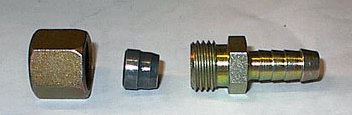
The connector on the other end of the flexible hose will be cut off and it will be attached to the copper pipe using a three-part coupling. A beaded pipe may be adequate but I'm not going to risk it. I'm using a compression fitting. A nut slips over the end of the pipe, then an olive inside and an end-piece with an 8mm O/D ridged nozzle to accept the hose. The nut and end-piece squeeze the olive to form a seal. I sourced this from a local hydraulics company called Pirtek  for £4.47. They actually sold me a four-part coupling but I modified one of the pieces with a countersink, to make it a three-part coupling and to reduce its weight from 45g to 25g. It all counts :-) I used two of these, one on each end of the high pressure pipe from the pump to the engine.
The fuel rail has a pressure regulator on it, with a metal fuel pipe that returns excess fuel back to the tank. This has a ridge for a flexible hose that will connect back to the copper pipe. Since this not at the same pressure as the inlet side, the flexible hose can be directly connected to the copper return pipe.
Before mounting the tank it is necessary to fit the fuel sender, which comes as part of the Digidash package. Making a hole in the tank without filling it with swarf is impossible. Richard made the hole upside-down, with the tank held on the workbench and then cleaned out around the hole inside the tank afterwards. His sender was mounted with self-tapping screws and a little panel bonder to help it seal. The sender comes with the digidash unit.
Some people use splined rivnuts to fit this as the tank walls on a plastic tank are fairly thin. Silicon selant will dissolve in petrol and then clog up the fuel injection system when exposed to heat.
The float arm is often too long for the tank. In order to get a full swing and hence reading on the display, I bent the float arm back on itself several times to effectively shorten it.
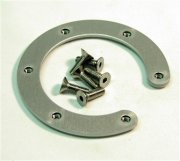
My sender requires a 40mm diameter hole. It has six 6mm mounting holes (at 60.4mm PCD) around it and a rubber washer seal. This clever little device seems to be the best ways to fit the fuel sender. It allows it to be clamped from within the tank by using a broken ring, with captive nuts, inside the tank. Not cheap, but the safest way to fit the sender in my view. This one comes from Burton Power but it is too big, so made something similar myself.
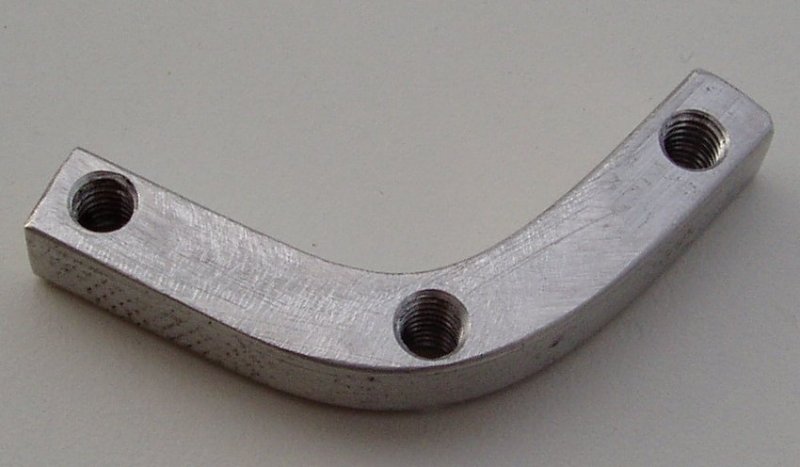
My solution was to use some 10 x 10 x 75mm aluminium, bent to allow three holes to be drilled, which match half of the holes on the sender. I then tapped these to a 6mm thread. There are two of these.

Chris fitted an 8.5 gallon plastic tank from Fisher Sportscars , which should give a range of around 300 miles of normal road driving. It is also shaped and baffled to ensure fuel is easily picked up and the tank can be emptied.
Fisher Sportscars recommend the standard 6.5 gallon tank though and I'm using this. It fits in the car better and has a collection pot moulded into the centre of the tank bottom. This will ensure better fuel pickup on cornering. It has a 50/51mm diameter tube at the top onto which the fuel filler cap is mounted.
It is important to trial fit the tank in place to ensure the sender and outlets are not fitted in the way of the mounting straps and and fittings don't hit the chassis rails. The tank has indentations where threaded inserts have been put in. You need to drill through the plastic behind these inserts to open up the holes. At the top is a filler hole and nearby are a fuel return and vent pipe inserts.
With hindsight: Plastic tanks have threaded metal inserts moulded into them and these can be an annoying source of leaks as they sometimes come loose. This happened on the fuel return coupling on my tank and it had a very slight leak. In my view it would have been better to spend a bit more money on an aluminium tank.
The chassis has four mounting points above the tank, to allow two straps to go underneath it. These straps are made from a bent steel 1/8" x 25mm flat. I tried aluminium but it is simply not strong enough. I got my straps powder coated as they a fairly exposed.
Protective foam is stuck to the straps to ensure the plastic tank is not damaged by the metal. I bought this from NF Auto .
With hindsight: My approach and location for the fuel pump works really well. The rubber mountings result in almost silent operation.
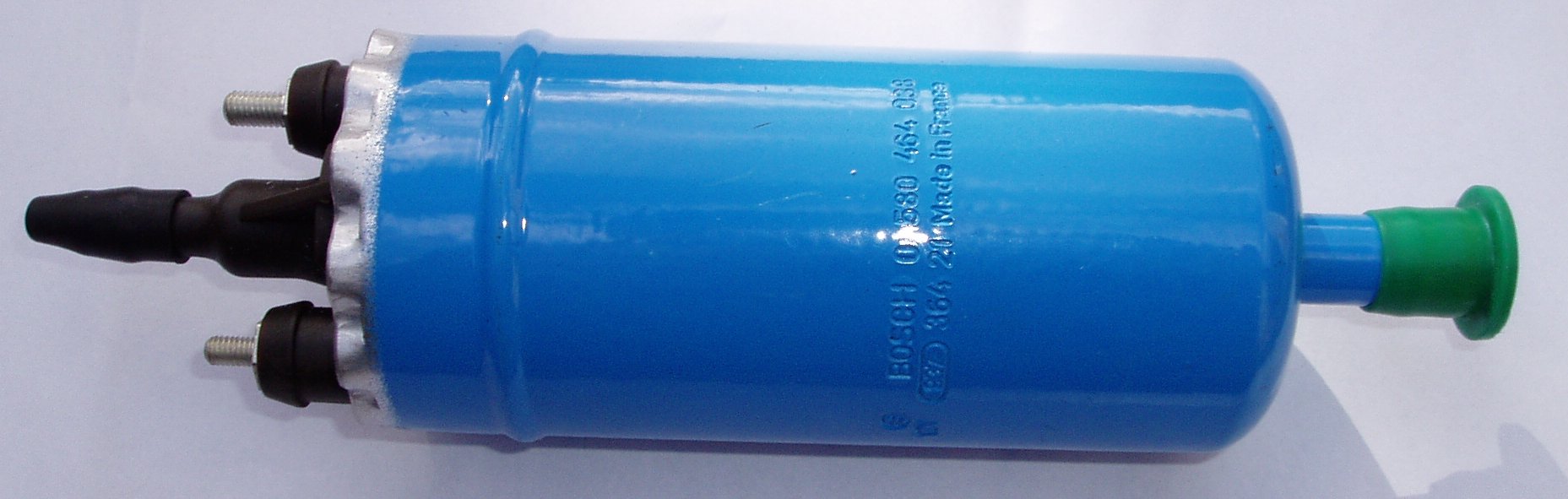
Chris opted for a Rover V8 fuel injection fuel pump because it is rated above the fuel rail pressure and has perfect ends to allow very easy connection. I bought an identical one on E-bay. It is a Bosch pump (part number 0 580 464 938). It weighs 645g and is 52mm in diameter. The terminals are marker + and - but it is very hard to spot the markings at the base of each terminal. The thicker terminal (4mm thread) is the negative one and the smaller one (3mm thread) is the positive.

The fuel pump can vibrate quite a lot and ideally requires some rubber bobbins to reduce the noise. This is typical of the sort of mount used to achieve this.
My rubber bobbins are relatively soft and flexible. A mount like the one shown above would allow the fuel pump to flap about far too much under acceleration and braking. For this reason my mount is fixed to the chassis using four bobbins.
The R1 wiring loom has wiring for the bike fuel pump and there is some intelligence behind the way it is controlled. It does not run continuously and when the fuel rail is up to pressure, the ECU stops the fuel pump. Ideally, I would run the new fuel pump off the same wiring but I wasn't sure it was up to supplying the current required by my new pump. Testing showed that the existing bike loom was perfectly capable of powering this fuel pump directly and so no additional wiring or relay was needed.
Some people also put a filter in line before the fuel pump. I'm going to add a transparent filter before the fuel pump initially. This will be a temporary measure, to try and catch any swarf left in the fuel tank, before it can get into the pump. I can get away with a temporary fixing as the fuel line is low pressure this side of the fuel pump. I don't see the need for one long term though.
With hindsight: This filter makes a lot of sense and I've left it in place.
June 2020 - I replaced this fuel filter for the second time.

Chris used a filter from a Ford Focus 2.0i to simplify the plumbing. The Fisher fuel tank has 10mm outlet and this connects to this pump 10mm inlet, using 10mm hose. The pump outlet is 8mm which connects to the 8mm inlet on the 2.0 Ford Focus fuel filter, using 8mm hose. The fuel filter has a 8mm output which connects to the 5/8" (8mm) fuel pipe to the front of the car. The Halfords part number for this item is HFF253.
June 2020 - I replaced this fuel filter with another Ford Focus item from Halfords.
In many builds, I've seen the fuel filter riveted to the chassis but this doesn't make sense to me as it is a consumable item and needs to be replaced. I fitted two 5mm countersunk rivnuts into the chassis to bolt a filter bracket to it. My brackets clamp the filter (rubber lined) and are powder coated. This means that both the filter and the brackets can easily be unbolted and replaced.
With hindsight: I should have planned the location of the fuel filters better. Access to the second filter is going to be really hard now the bodywork is on. I could have got away with one smaller and cheaper filter before the pump. You need a filter before the pump to capture the swarf from making holes in the tank. It is impossible to remove it all before installing the tank.
As it happens, I had to cut an access panel in the boot floor anyway, when the rear chassis rail was fixed. This now gives good access to the fuel filter.

I'm using a Mocal 2" locking 'Aero' cap (part no. CAP3SF). For SVA I added the lead-free flap kit (part no. MOCLFK1) and a ring with captive nuts at 3"/76mm PCD (part no. RIN2). This needs a fuel hose with a 51mm internal bore to connect to the tank and two stainless-steel, 50-70mm hose clips to fix it.
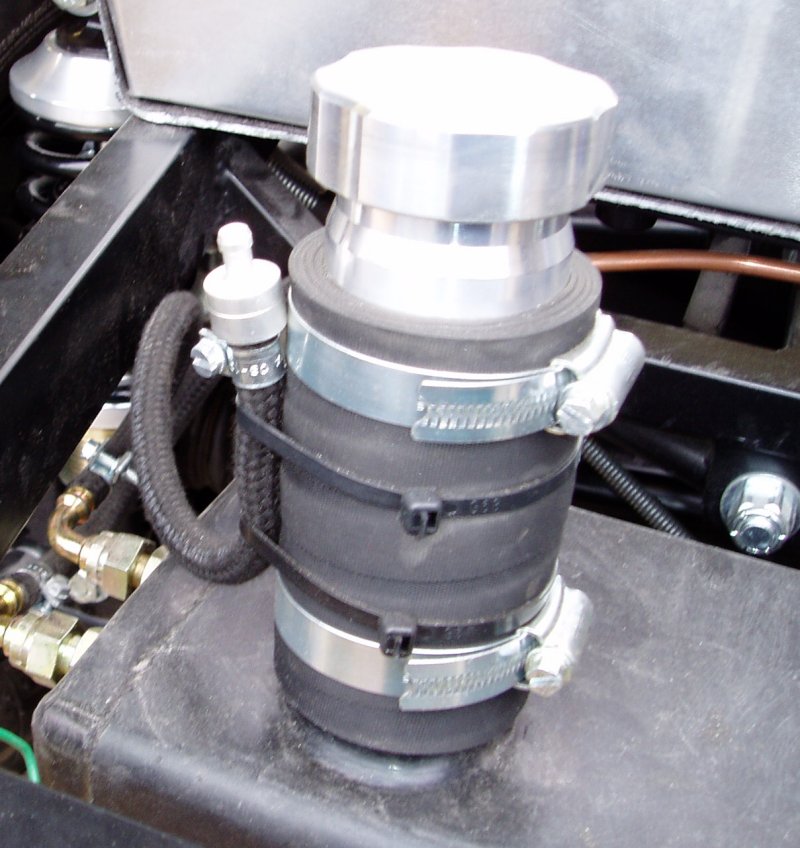
This is required on a bike-engined car since the fuel filler cap will not vent enough air during hard track use, resulting in the tank imploding. An R1 Fury will drink fuel under hard track use, going down to as little as 10mpg. The Kit Car Workshop supplied this very simple, light-weight vent for me.
With hindsight: I should have placed these somewhere with easier access. I just assumed it would work and never need to be touched but, mine failed after only a few months and leaked petrol. I replaced it with a 1/4" inline breather (TRL7) from Think Automotive. As hort time later I removed it completely. My fuel filler cap vents air into the tank perfectly well.
The ECU has a self-diagnostic function in order to ensure that the engine is operating correctly. If it detects a problem, the engine operates under 'substitute characteristics' and the engine warning light comes on (on the bike instrument pod). The light comes on for 1.4 seconds after the ignition switch has been turned on, as a bulb check feature. This basically a self-contained system, controlled by the ECU.
|
|
|
|||||||||||||||||||||||||||||||||||||||||||||||||||||||


