 |
|
|
|||||||||||||||||||||||||||||||||||||||||||||||||||||||
|
|
|
|||||||||||||||||||||||||||||||||||||||||||||||||||||||
This section details my thinking around the suspension design and includes some updates.
Rose-jointed suspension is an option on some kit cars and this includes the Fury. Rose joints are expensive but provide a more rigid suspension and more adjustability, which are good thing and improves handling. It can seem a little harsh on typical UK roads though, as it transmits much more back through the chassis. The other downside is that they do wear relatively quickly, especially if the car is used in all weathers.
Rose joints are not an option on live axle cars as some compliance is needed within the suspension design. There are also varying quality of rose joints and the best ones tend to have a teflon liner and a rubber boot around them to provide protection from the weather and dirt.
The Fisher Sportscars  upgrade consists of 22 rose joints and the required spacers for a reasonable £300. Other owners have bought TSMX8 rose-joints from Autosport Bearings . These are all alloy steel, 3-piece units with PTFE liners, and over twice the URSL (Ultimate Radial Static Load) of the ones supplied as standard, at over 16,000lbs. They cost £13.79+VAT each. That works out at £357 for the set.
Advice from the Bike Engined Cars Group and the Sylva Chat List seems to suggest that Powerflex PF102 poly bushes in the standard (normally metalastic bushed) wishbones are also a good option to consider. These offer lower maintenance, low compliance, and low wear. You don't have the level of adjustability that rose-joints give but you still have camber (outside ball joints) and toe adjustment which is all you really need.
Powerflex PF102 bushes are a 'universal' top-hat design. You need to drill out the stainless ferrule to 12mm or 1/2 " (whichever size bolts you're using) and use a hacksaw to cut the ferrules in half and also to cut the 'brim' of the hat down, giving you a thinner brim and poly 'washer' offcut. This makes the bush short enough to fit in the chassis mounts. Mount the brim to the rear of the car as this is the direction of all loads. One bush does one wishbone as you're actually only using half the bush in each leg of the wishbone. If you have bushes with a 1/2" hole, you must be use 1/2" bolts (make sure the chassis is drilled for these before you start assembly. Having an M12 bolt through a 1/2" hole makes the car sloppy and impossible to set up.

|
You generally have a choice when it comes to the front uprights. The standard is now to use Sierra uprights but the old MkII Escort ones are lighter and offer a better castor angle. Getting hold of them proved very problematic and I got mine from a local scrap yard. Cut down ready to go to Fisher Sportscars for modification, they weigh about 3.1Kg. I reckon this about what they will weigh when they come back as I've left a fair bit of spare metal on them but, need some inserts added. In the end I found two sets and bought both!
|
A rather more expensive alternative is to use new custom uprights from Raceleda . Westfield also sell new fabricated uprights and Stuart Taylor are also now selling some.
These are custom made to suit the chassis. The Fury uses a rocker to allow in-board shocks/springs at the front. These need to be packed with grease and one approach that was worth copying to acheive was is to fix a grease nipple into the top face.
With Escort mk II uprights the upper wishbone is connected using a Chevette ball joint (Motaquip part no VSJ 367).
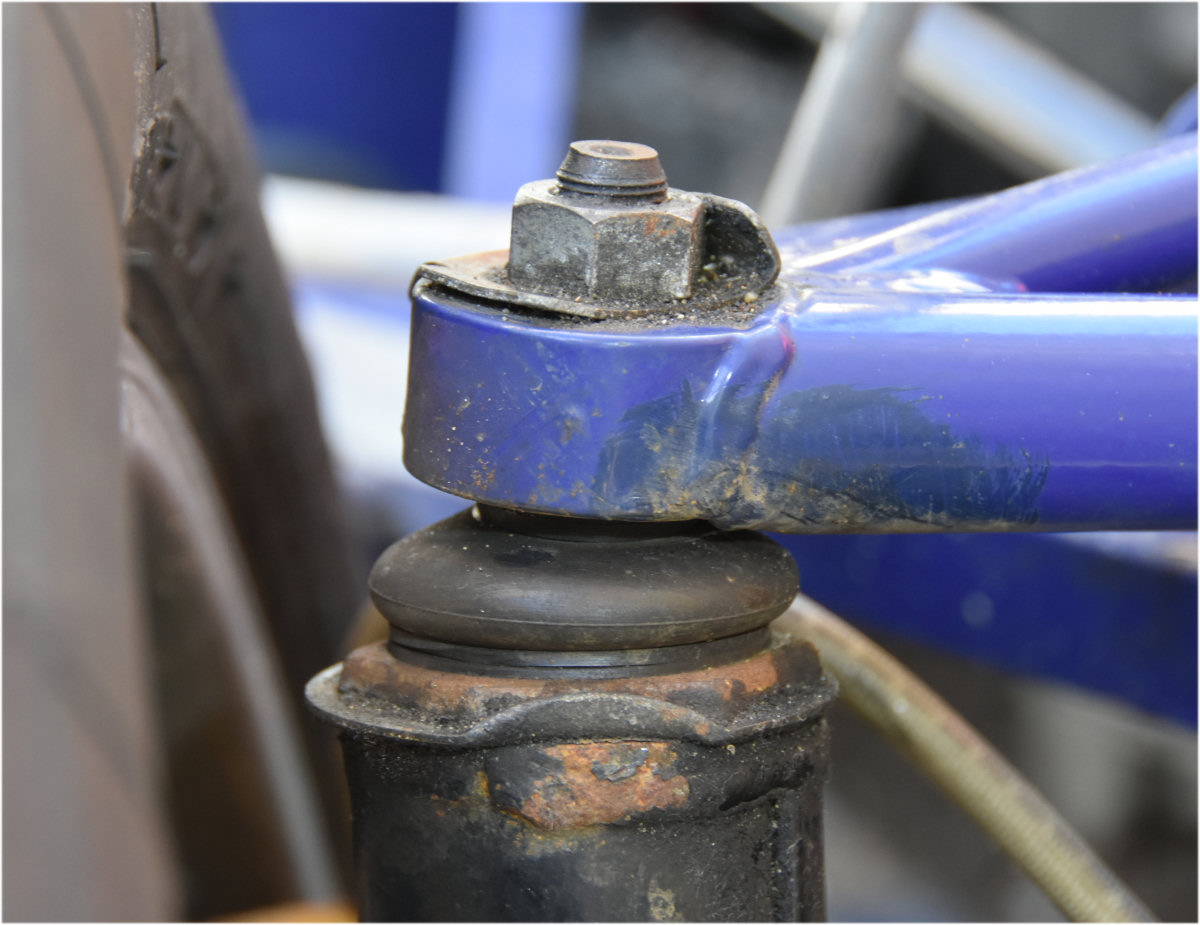
| Mine is one of the later cars with Escort mk II uprights though and the wishbone knuckle joints are from a Mini Metro (MotorQuip part no VSJ 473), as also used on the Sierra uprights. This is because it provides more strength. Photo taken April 2018. |
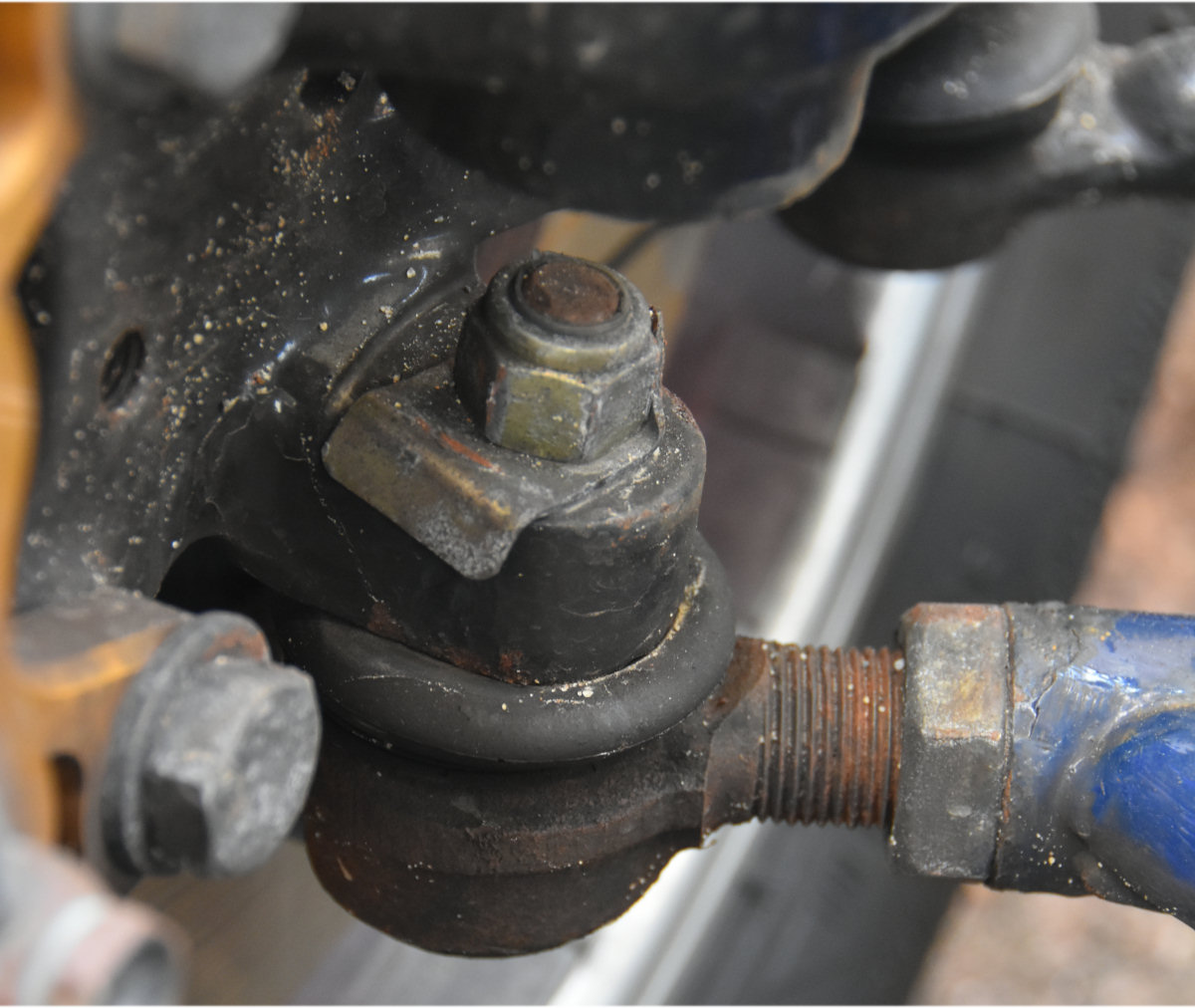
| With Escort mk II uprights the lower wishbones use a Sherpa Van track rod end with right-hand thread (part No. QR1774). Photo taken April 2018. |
Some people have mentioned issues with the rubber boot getting trapped and failing very quickly but I've not seen this. The solution seems to be to taper the bottom edge of the mount on the upright with an angle grinder but I've not found this to be a problem.
On a IRS Fury with Sierra upright (angled wishbone), the front bottom ball joint is a LandRover track rod end (part no RTC 5867) and the top ball joint is a Metro ball joint (MotorQuip part no VSJ 473).
Covered under the steering section.
The default springs and dampers supplied seem to vary but whilst good quality, they are all pretty heavy. Richard used Nitron NTX dampers and springs to save weight. This was an expensive weight saving exercise but, his complete front damper with spring was only 2.05Kg.

| These have now been replaced by the NTR model and you get a full kit of four adjustable dampers fitted with uprated springs as well as all the spacers etc. that are required to complete the job. They are CNC machined from aluminium, the dampers are very light, weighing 1565g (front) and 1635g (rear) complete. Fitted with sealed spherical bearings as standard, they are able to run inverted, and being gas monotube (as all F1 dampers are), they are very fade resistant and provide extremely good short-stroke damping control. All Nitron dampers are fully rebuildable. |
This was a tough decision that required some careful consideration but the first thing I'd end up upgrading to improve handling and reduce weight are the springs/dampers, so rather than waste money on the usual items, I'm using the Nitrons from day one. I'm using a standard road set set up and ride height since my car is mainly for road use. The Kit Car Workshop recommend 180lb springs at the front and 130lb springs at the rear. Guy at Nitron needed the following information for my order:
With hindsight: March 2010 - Upgraded springs to 225lb front and 180lb rear. This has made a massive improvement to the ride and handling. See my March 2010 diary entry.
There are two options with the rear suspension design on the Fury, live axle or fully independent rear suspension. Popular belief is that the live axle is lighter but in reality a 1.6 Sierra IRS setup is about the same weight. More importantly the IRS solution results in less unsprung mass. My preference is for an IRS setup and it is definately better suited to road use.
The adjustable rod on the lower rear wishbone faces towards the front of the car. The upper wishbone is also handed and the offset on the top wishbone must also be towards the front of the car. The hubs are also handed and their orientation depends on whether you are using disk or drum brakes. For disk brakes the flat side of the hub must face towards the front.
The recomended setup from the build manual for the IRS Fury are:
Rear: Toe-in = 1-2mm and no negative camber at normal ride height.
Front: Toe-in = 3-4mm, ¾ to 1º negative camber. This means the wheel is leaning in at the top slightly.
During the build, I set the suspension geometry up as best I could. Fisher recommend that the front wheels should have a toe-in of 3-4mm. This is checked by measuring the distance between the rims at the front edge of the wheels and then take the distance between the rear-most edges. The difference between the two measurements is the amount of toe in (or toe out if the front edge measurement is greater than that of the rear edge).
Front camber adjustment is done by rotating the lower ball joint in/out of the lower wishbone. This resolution of adjustment is thus limited to one 360º rotation of the ball-joint. Given the thread pitch and the separation between the wishbone mounting points on the upright, this equates to about more than 0.5º change per rotation of the ball-joint, so it is not always possible to hit the target ¾ to 1º negative camber. Note that changing this will also alter the toe-in.
The suspension was designed with a given ride height in mind and messing about with it will affect to roll centre and handling. I'm going with the standard road settings, which are 5" (127mm) chassis clearance at the front and 6" (152mm) chassis clearance at the back. Measurements should be made with the driver in the car.
The RGB specify 75mm minimum for the 750 race series, which gives a minimum setting. A few owners report running a Fury with 80mm ground-to-sump clearance and 100mm ground-to-chassis clearance, resulting in some care being required over speed bumps.
|
|
|
|||||||||||||||||||||||||||||||||||||||||||||||||||||||


