Bodywork & Aerodynamics
In my Fisher Fury R1, you have to climb over the bodywork, yet it is not a structural element. You have a relatively low side sill in the chassis (to enable a variant with doors), which lowers the rigidity and overall strength and you also have the inconvenience of having to climb over the bodywork to drop down into the chassis. With this new car, I plan to eliminate both of these issues, by combining the bodywork and chassis, thus lowering the bodywork whilst increasing the height of the chassis sill.
Front
The 'bonnet' on this new car is not going to be compromised by having to squeeze an engine under it. It is also not going to need huge vents and ducts for cooling as the radiator will also be in the back of the car. This will result in a very low drag coefficient and provides a lot more flexibility in the styling. Because the car is so light, there is also no need for air ducting to the front brakes.
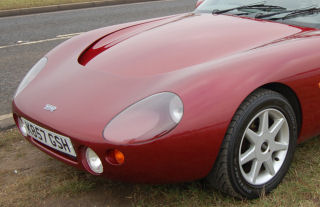
| Overall, it should be possible to make the car very slippery at the front and all of the lighting will be designed to assist in this. I'm currently thinking of a simple design, similar to the TVR Griffith but, I don't need the opening bonnet, front grill or driving lights. The trick is going to avoid it looking too bland and boring. I'm also thinking that a curved number plate would reduce resistance (I know this is not strictly legal). |
Because they isn't a front grille on this car, I plan to have a shallow, oval indentation of roughly the same shape, into which the front number plate will sit. A 'fake' grille that looks a bit like the above photo.
Rear
The rear bodywork will provide plenty of room the engine and will feature two large air scoops down the sides, to provide air to cool and feed the engine. There will also be vents on the top surface to let hot air out.
The rear of the bodywork will have a recess for the number plate.
Roof
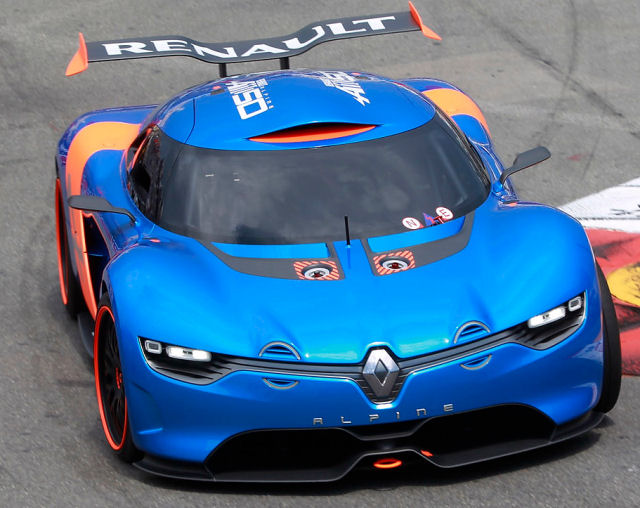
| I'm planning a removable roof (hard top) and I love the roof air intake on this Renault Alpine A110-50 concept car and would like a similar implementation to provide the ram-air effect into the bike engine. This would simply be a duct to the intake on the roll-bar, which would be used when the roof is not in place. Love this windscreen design too! |
Underside
The central tub will have a completely flat floor and I plan to use a flat floor panel under the front, which doubles as a front splitter. There will also be a flat diffuser under the engine that curves up at the rear.
Aerodynamics
I've made a conscious decision for the car to not have huge amounts of down force. I realise this will make the car slower around corners (and faster in a straight line) but, I but want the suspension design to focus on keeping the car connected to the road, whilst the providing the highest quality feedback. A lot of this feedback will be swamped if the suspension has to also handle the huge forces generated by large wings and other aerodynamic surfaces. Negating the need for huge down force also means has the side effect of the bodywork design being much more aesthetically pleasing, more Jaguar E-type and less LMP racer.
Materials
I would love to do the bodywork in raw carbon fibre but I fear the costs will be too high. I'm compiling a list of companies that could do it though just in case:
Colour
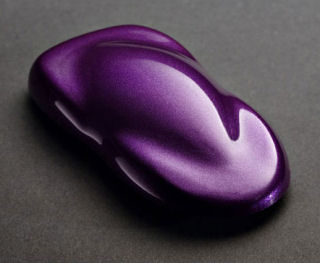
| My first choice of colour for this car is currently metalic purple. Something like this. |
Other colours I'm looking at though are metallic blue.
There will also be some black coloured parts lower on the car and it will features light silver/alloy wheels.
Stripes
This car is all about a clean, beautiful design and I'm not planning to distract from this with any kind of stripes or transfers.
Badges
There will be no badges on this car to distract from the clean, beautiful lines and to reduce aerodynamic drag. There will be subtle, indented letters etched into the bodywork along the rear, indicating the chosen branding.