 |
|
|
|||||||||||||||||||||||||||||||||||||||||||||||||||||||
|
|
|
|||||||||||||||||||||||||||||||||||||||||||||||||||||||
Effective braking is largely dependent on the front brakes and quite often light-weight kit cars can get away with drum brakes at the rear. My brother's Striker has a live axle rear-end with drum brakes and there has never been any noticeable drop in braking performance, even after a whole day with the three of us, taking it in turns to hammer it around Llandow circuit.
I've opted for all-round disk brakes to minimise weight, provide excellent feedback and to guarantee that brake fade will not be an issue. Brakes are also the most important safety feature on any car, so I'm not cutting corners.
Front Brake Disks & Calipers

| I've bought some new HiSpec 4-pot calipers. These should save on unsprung weight and provide awesome stopping power. The calipers are 925g each. The 247mm and 260mm disc versions come with mounting ears, to avoid the need for a mounting bracket. |
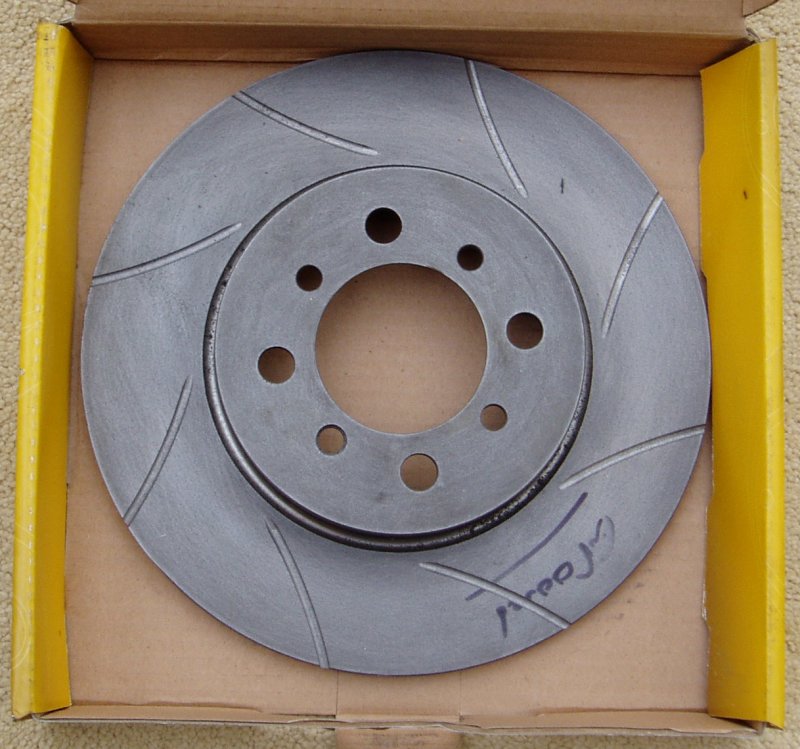
| These are the matching 260mm x 7mm grooved discs. |
Standard Mk2 Escort discs are 247.5 mm in diameter and the internal diameter is 139.8 mm. For SVA, the caliper bolts need a locking plate with tabs that are bent to stop them shaking loose. Having worked out which side of the disk is bolted to the alloy bells, you can choose which way you want the grooves pointing. The disks are bolted to the bells with 8 bolts, torqued to 11Nm and with some Loctite thread locker 242 for extra security. The disk assembly is then bolted to the pattern alloy hubs up to 50lb-ft with spring washers and thread locker for safety. The mating faces between hub and disc have to be spotless.
There are now several other cheaper options:
 now sell billet aluminium calipers which are a direct bolt on replacement for the standard Ford M16 calipers (fit the standard Escort/Cortina 247mm discs). Not sure on prices though.
at £320
now sell billet aluminium calipers which are a direct bolt on replacement for the standard Ford M16 calipers (fit the standard Escort/Cortina 247mm discs). Not sure on prices though.
at £320

|
These are from a Ford Sierra. I bought an old pair to exchange for some reconditioned ones from Used Ford Spares . Part no. is DC71346.
You also need to do this as Ford Spares don't supply the caliper carriers with the calipers. These allow the caliper to float across the disk. The caliper has a piston on one side so must be able to move in and out to apply even pressure to both sides of the disk. The reconditioned calipers also came with the little rubber boots and some grease for the sliders. I'd been struggling to find these rubber boots on their own. The reconditioned calipers weigh 2060g each and the caliper carriers weigh 615g. For SVA, the caliper bolts need a locking plate with tabs that are bent to stop them shaking loose. |
An alternative is to use Hi-spec rear calipers with built-in handbrake mechanism. The trouble is that these things don't exist commercially yet and people have been waiting literally years for them to be developed and launched as a product. As much as I'd like to use them and save several kilograms in weight, I've had to draw a the line here to stay within my budget.

|
Normal Sierra rear disk hubs (from an XR4x4) have elongated ears on the hub to which the caliper assembly is mounted. On kit cars, custom caliper brackets are required to duplicate this function. I ordered mine from The Kit Car Workshop .
|
The rear calipers are mounted upside down, which puts the bleed nipple and inlet at the bottom of the caliper. The calipers must be turned the correct way up to bleed the brake fluid, otherwise the caliper will remain full of air. Because the calipers are upside down, the bleed nipple and flexi inlet need to be swapped over. In the pictures below you can see the bleed nipple is at the front of the caliper (with the red tag) and the main inlet is at the rear. You take out the bleed nipple and move to the rear inlet hole, then attach the flexible hose into the front hole. This positions the flexible hose out of the way of the wheel.
have developed a mechanical handbrake assembly that makes it possible to fit any floating piston aluminium (or steel) brake calipers to the rear wheels of kitcars.
sell an aluminium equivalent to the Sierra rear caliper.
have been working on an ultra-light rear caliper with handbrake mechanism for far too long. This is the nearest equivalent, which would work with the top item.
The Mintex 1144 pads seem to be good and at a reasonable price, so and I'm going to start with these on my car. Mintex have an application guide on-line but this didn't help me find the required parts numbers. The ones I've got are labelled: CTECH MDB1890M1144 (FMSI:D109, WVA: 20323 144) for a Lotus Elise 96 onwards.
Mintex no longer do Sierra rear pads so I'm using standard off-the shelf items, since the rear brakes don't do much in terms of stopping the car. These are TRW Lucas parts number GDB472 (Girling 3322936404729).
Handbrake
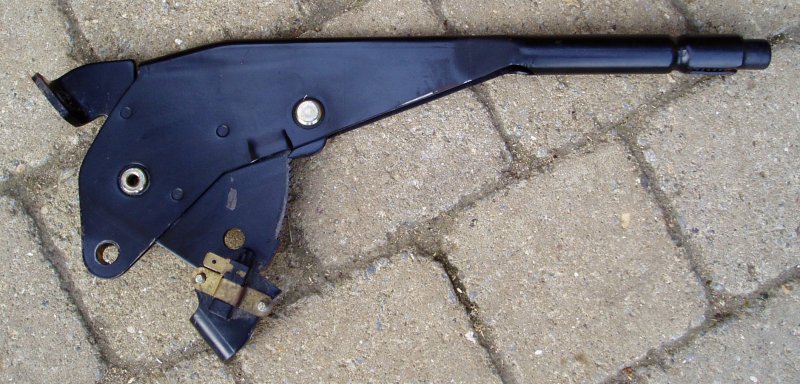
| My Fury handbrake was bought on eBay and was from a Ford Escort. It has an electrical switch to show when it is on/off [650g]. It is not brillaint quality and has some lateral movement. |
The handbrake cable on my Fury is from a standard 2.0 Sierra and is one long unbroken length of cable. The outer sheath routes along the rear wishbones at either side then fits through the chassis brackets. It is very over engineered and very heavy. I plan a much thinner and lighter solution in ths car.
The handbrake warning switch typical connects to ground.

|
I've opted for the twin cylinders with bias bar, to provide better control over front to rear bias. This is supplied by Fisher Sportscars . You can buy a twin master cylinder unit with the front/rear bias preset. You need to specify which one you want up front or you will get a spare hole to fill in the bulkhead. The two cylinders are different, the .625 is the front and the .75 is the rear.
|

|
Some people claim that the bulkhead has a tendency to flex under hard braking. Fisher Sportscars have addressed this with an additional bracing bar above the brake cylinders in the 2006 chassis.
|
The brake fluid reservoir has a 'low fluid' sensor (switch), which drives the brake lamp on the Digidash. The same lamp is also driven by the handbrake switch.
The sharp edges rule and projects rules apply to the footwell area.
Brake Bias Adjustment

| You can get dash mounted bias adjustment knobs to allow you control the braking bias (front/rear) whilst on the move. These will not pass the SVA test though. There is not a lot of room to fit these and the cable is often routed through the side of the footwell as shown above, to avoid too tight a radius in the cable. You can get 90° bevel gear adaptors though, which allow the cable to go straight up to the dash area. Personally, I don't want the added complexity, cost and weight this adds but I can see they make sense for frequent track work. |
The Wilwood Engineering web site describes the best way to set up the balance bar.
I've gone for an adjustable brake bias bar but, for the test, this must be locked in place. There are several options to achieve this:
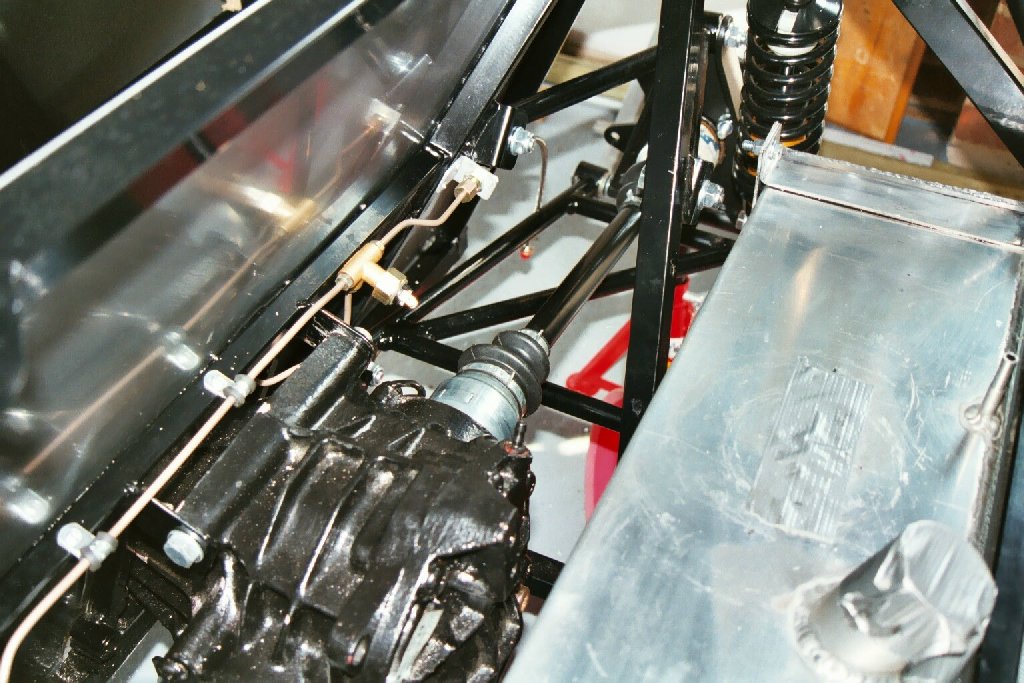
or Zeroclips . These are riveted to the chassis at 100mm intervals (maximum distance specified in SVA manual). The front pipe runs to the front of the chassis where a 3-way union splits the pipe into two, one to each chassis tab for attaching the front braided hoses. The rear pipe runs down the centre of the car to a 3-way union in front of the differential. This also splits the circuit into two runs, one to each bulkhead fitting for the rear braided hoses.
Copper/nickel (90%/10%) pipes are sometimes referred to as kunifer brake pipes and are slightly more expensive. The added nickel provides improved corrosion resistance. All the fittings used are metric (M10x1) with the exception of the master cylinder ports. For Girling master cylinders the brake port is 3/8" UNF and the feed port is 7/16 UNF which needs 1/4" or larger feed pipe. A male/male union with a short length of rubber hose will connect to the brake fluid reservoir, which is a twin item with level sensor for SVA.
A decent cam-action flaring tool is required to connect the braking system up.
. This list assumes no hydraulic brake light switches are used in the pipe work (as described below).
| Quantity | Description / Usage | Part Number | Price each (ex. VAT) |
| 1 | 3/16" copper-nickel brake pipe, 25' roll | T14M | £13.65 |
| 2 | 3-way connector, 10mm x 1mm thread, for front and rear split | B544 | £6.10 |
| 6 | Brake nuts, male, 10mm x 1mm thread, to 3-way connectors | B620 | £0.26 |
| 4 | Brake nuts, female, 10mm x 1mm thread, to through connectors | B627 | £0.44 |
| 2 | Brake nuts, female, 3/8" UNF x 24tpi thread, to master cylinders | B576 | £0.42 |

|
Goodridge stainless-steel, braided hoses are used at each wheel, to connect the brake pipe to the calipers. These needs to the correct length for the Fury installation so I bought mine from The Kit Car Workshop . They supply front hoses with a 90° hose fitting to get better clearance on the hoses.
|
|
Richard used a 4-way union, just in front and to the right of the differential to connect the brake light switch. These type of switches don't work too well in practice and require a fair push on the pedal to operate but, are fine for normal road use and to pass the SVA test.
|

| All of my brake lights are LED so I can use a low current switch to drive them directly (Maplin part number is GW73Q and is rated at 3A). |
I need to mount the switch in such a way that pushing the pedal closes the 'normally open' contacts on the switch. Because the pedal has quite a lot of movement, the switch is mounted half way between the footwell wall and the pedal's normal resting point. This ensures that even with all the pedals pushed as far down as they go, my foot will not hit the switch and the activation bar on the brake pedal arm will not hit the back of the footwell.
|
|
|
|||||||||||||||||||||||||||||||||||||||||||||||||||||||


